
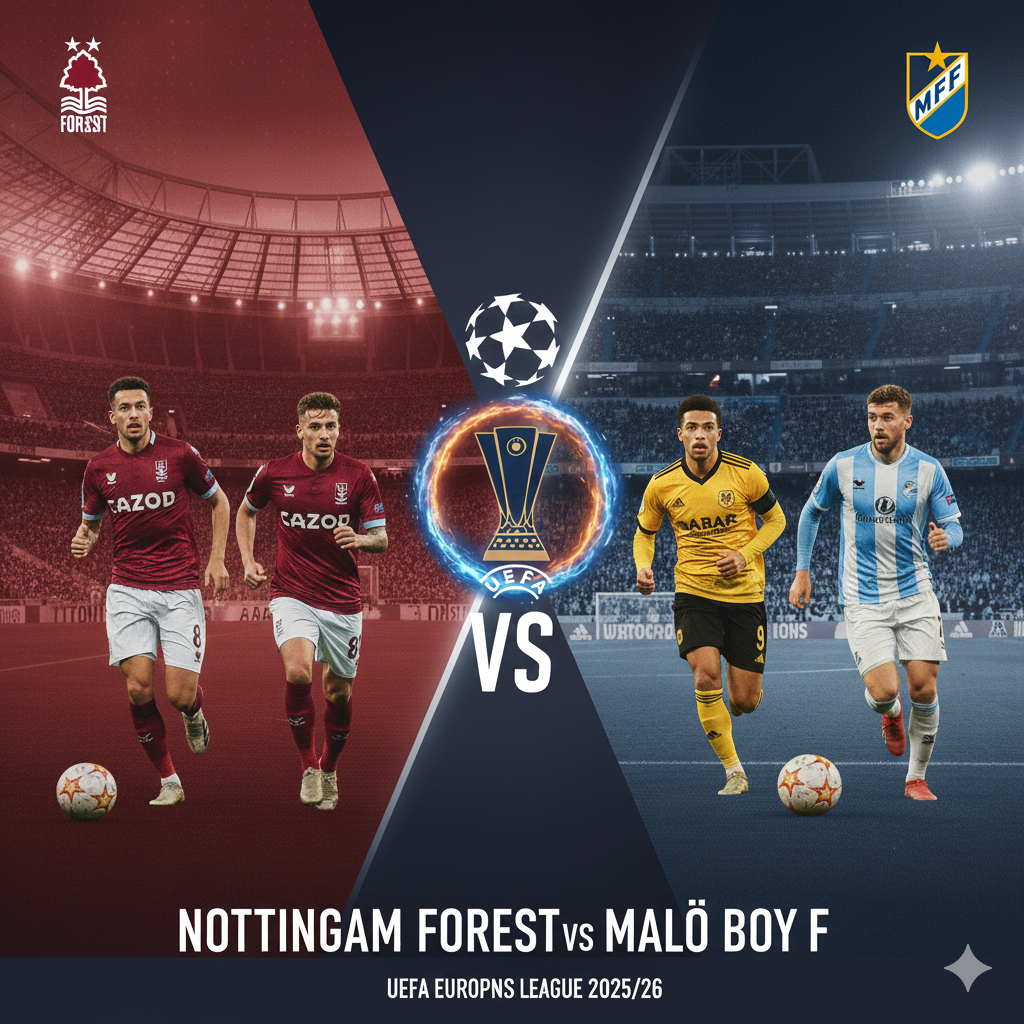
Nottingham Forest vs Malmö FF Match Preview – UEFA Europa League 2025/26
Date: Thursday, November 27, 2025
Kick-off: 20:00 GMT (21:00 CET)
Venue: The City Ground, Nottingham, England
Competition: UEFA Europa League – League Phase (Matchday 5)
Referee: TBC
Match Overview
The historic City Ground hosts a crucial Europa League encounter as Nottingham Forest welcome Swedish champions Malmö FF in a fixture that could define both clubs’ European trajectories. This meeting between two former European Cup finalists—separated by 40 years of contrasting fortunes—carries significant implications for qualification hopes and continental ambitions.
⚡ Boost Your Match Experience!
Think you know how this game will end? Turn your prediction into profit!
👉 Join now, claim your welcome bonus, and place your bet before kickoff.
🎁 Fast payouts | 💰 Daily bonuses | 📱 Easy mobile betting
Nottingham Forest sit precariously in 23rd position with just five points from four matches, their Europa League campaign characterized by frustrating inconsistency and managerial upheaval. The appointment of Sean Dyche following Ange Postecoglou’s brief and unsuccessful tenure has brought tactical stability, evidenced by their recent 3-1 victory at Leeds United that showcased improved attacking fluidity and defensive organization.
Malmö FF arrive at the City Ground occupying an even more precarious 33rd position with just one point from four matches—their Europa League campaign has been a nightmare of defensive collapses and missed opportunities. Three consecutive defeats, including humbling losses to Midtjylland (3-2), Panathinaikos (1-0), and most recently a goalless draw with Sturm Graz that felt like another missed opportunity, have left the Swedish champions teetering on the brink of elimination.
Both clubs desperately need victories to maintain realistic playoff qualification hopes. Forest requires consistent points to climb into the top 24, while Malmö face an uphill battle simply to avoid finishing in the bottom third. The contrasting pressures create fascinating dynamics: Forest playing for survival from a position of slight advantage, Malmö fighting with nothing to lose as their European dream slips away. The stage is set for an intense, high-stakes encounter where desperation meets opportunity at one of English football’s most atmospheric venues.
Current Form Analysis
Nottingham Forest Form
Europa League: W-L-D-W (5 points from 4 matches, 23rd position)
Premier League: W-D-L (Last 3 matches)
Overall: W-W-D-L-W (Last 5 matches)
Home Record: Mixed across competitions
Nottingham Forest’s season has been defined by managerial turbulence and tactical uncertainty. The dismissal of Nuno Espírito Santo on September 8th, followed by Ange Postecoglou’s disastrous eight-match winless tenure that culminated in a humiliating 3-0 home defeat to Chelsea, left the club’s European ambitions hanging by a thread. Sean Dyche’s appointment on October 21st has brought much-needed stability and tactical organization.
Under Dyche, Forest have demonstrated improved defensive structure and attacking purpose. Their recent 3-1 victory at Leeds United showcased clinical finishing from Morgan Gibbs-White, Ibrahim Sangaré, and Elliot Anderson, with the team controlling key moments despite possessing just 46% of the ball. This pragmatic approach—defending solidly while capitalizing on transition opportunities—mirrors Dyche’s successful blueprint at previous clubs.
In Europa League competition, Forest’s record tells a story of narrow margins and missed opportunities. Their opening victory over Real Betis provided initial optimism, but a 3-2 home defeat to Midtjylland exposed defensive vulnerabilities. The goalless draw at Sturm Graz demonstrated improved organization but highlighted ongoing attacking impotence. Their 2-0 home victory over Porto offered renewed hope, suggesting they’re capable of controlling matches against quality opposition when tactically disciplined.
The statistics reveal concerning patterns: Forest have scored just six goals across four Europa League fixtures while conceding five. Their expected goals (xG) suggests they’re creating decent chances but lacking clinical finishing in crucial moments. Defensive organization has improved under Dyche, with the clean sheet against Porto demonstrating growing confidence in their structure.
Domestically, Forest’s form has stabilized after early-season chaos. Sitting in mid-table after their recent Leeds victory, they’ve demonstrated capacity to compete against Premier League opposition while managing European commitments. However, the 2-2 home draw with Manchester United and 2-0 defeat at Bournemouth highlight ongoing inconsistencies that could undermine European aspirations.
Malmö FF Form
Europa League: L-L-L-D (1 point from 4 matches, 33rd position)
Swedish Allsvenskan: W-D-L (Last 3 matches, finished 6th)
Overall: W-W-D-L-L (Last 5 matches)
Away Record: Particularly poor in European competition
Malmö’s Europa League campaign ranks among the competition’s most disappointing performances. The Swedish champions entered with hopes of progressing to knockout stages but have been systematically dismantled by opponents of varying quality, exposing fundamental defensive frailties and tactical limitations that domestic success masked.
Their opening 3-2 defeat to Midtjylland set an unfortunate tone—conceding three goals at home suggested defensive vulnerabilities that subsequent matches confirmed. The 4-1 thrashing by Roma represented their nadir, with Italian quality overwhelming Malmö’s organization through superior technical ability and tactical sophistication. The 1-0 loss to Panathinaikos was particularly frustrating, as Malmö dominated possession (58%) yet couldn’t convert territorial advantage into goals.
Most concerning is their recent goalless draw with Sturm Graz at home—a match they absolutely needed to win to maintain realistic qualification hopes. Creating just 0.85 expected goals against modest opposition highlighted their attacking impotence and lack of creative spark when facing organized defenses. This pattern of dominating possession without creating clear chances has plagued their European campaign.
Defensively, Malmö have conceded seven goals in four Europa League matches—an average of 1.75 per game that reflects systemic organizational issues. Their defensive line sits too high against pacy opponents, creating spaces in behind that better teams ruthlessly exploit. The midfield provides insufficient screening, allowing opponents to progress through central areas with alarming ease.
Domestically, Malmö finished sixth in the Allsvenskan with 49 points from 30 matches—a disappointing campaign by their usual standards. Their recent 2-1 victory over GAIS provided a confidence boost heading to England, with goals from Daníel Tristan Guðjohnsen and Sead Haksabanovic demonstrating attacking potential that has been absent in European competition.
Away form in Europe has been particularly concerning. Malmö have looked overwhelmed by the intensity and quality of elite European football, struggling to impose their game plan in hostile atmospheres. The City Ground’s intimidating environment will test their mental resilience and tactical discipline to breaking point.
Head-to-Head Record
Total Competitive Meetings: 0
First Meeting Between Clubs
This represents the first-ever competitive meeting between Nottingham Forest and Malmö FF, creating genuine intrigue and tactical uncertainty. Neither manager possesses specific opponent knowledge or historical blueprints, forcing reliance on general principles and recent form analysis.
Historical European Connection
While they’ve never met competitively, both clubs share a unique connection through the 1979 European Cup final. Nottingham Forest, under legendary manager Brian Clough, defeated Malmö 1-0 at Munich’s Olympic Stadium to claim their second consecutive European Cup. That victory cemented Forest’s status as European royalty and represented Malmö’s peak achievement—reaching a continental final despite Swedish football’s peripheral status.
The historical context adds romantic subtext to this encounter. Forest, two-time European Cup winners, face Malmö, the Swedish club that came closest to continental glory. However, current circumstances bear little resemblance to 1979’s glory days. Both clubs occupy precarious European positions, fighting for survival rather than supremacy.
This historical connection won’t influence on-field proceedings, but it provides narrative depth to an otherwise straightforward Europa League fixture. Malmö may draw inspiration from their previous meeting’s proximity to triumph, while Forest can reflect on their European pedigree when moments demand composure and quality.
Team News and Injuries
Nottingham Forest
Definitely Out:
- Oleksandr Zinchenko (Injury) – Defensive versatility unavailable
- Angus Gunn (Injury) – Backup goalkeeper sidelined
- Callum Hudson-Odoi (Injury) – Creative winger missing
- Chris Wood (Injury) – Experienced striker absent
- Dilane Bakwa (Injury) – Wide option unavailable
- Douglas Luiz (Injury) – Midfield depth reduced
- Ola Aina (Injury) – Fullback option missing
Available for Selection:
- Matz Sels (Goalkeeper) – First-choice shot-stopper
- Morgan Gibbs-White (Captain, Attacking Midfielder) – Creative hub and goal threat
- Ibrahim Sangaré (Midfielder) – Box-to-box dynamism
- Elliot Anderson (Midfielder) – Recent goal-scorer in good form
- Arnaud Kalimuendo (Forward) – Pace and movement
- Igor Jesus (Forward) – Physical presence leading the line
Forest’s injury list significantly depletes squad depth, particularly in attacking areas. The absence of Chris Wood removes an experienced target man whose physical presence and aerial dominance would have troubled Malmö’s defense. Callum Hudson-Odoi’s unavailability eliminates a creative wide option capable of one-on-one situations that unlock defensive blocks.
Douglas Luiz’s midfield absence places additional responsibility on Ibrahim Sangaré and Ryan Yates to provide both defensive screening and progressive passing. However, Sangaré’s recent goal-scoring form—netting against Leeds—demonstrates his capacity to arrive in dangerous positions and contribute offensively beyond traditional defensive midfield duties.
Morgan Gibbs-White remains Forest’s most important player. The captain’s creativity, vision, and goal-scoring threat make him the focal point of attacking patterns. His understanding with Elliot Anderson—both scoring at Leeds—creates a potent partnership capable of unlocking defensive organizations through quick combinations and intelligent movement.
Sean Dyche faces tactical decisions regarding formation and personnel. A 4-2-3-1 system with Gibbs-White as the attacking midfielder behind a lone striker appears most likely, providing defensive solidity while maintaining attacking outlets. Alternatively, a 4-4-2 could offer greater physicality and directness against Malmö’s vulnerable defense.
Malmö FF
Definitely Out:
- Arnór Sigurðsson (Injury) – Winger unavailable
- Erik Botheim (Injury) – Striker sidelined
- Lasse Berg Johnsen (Injury) – Midfield absence
Available for Selection:
- Johan Dahlin (Goalkeeper) – Experienced shot-stopper
- Pontus Jansson (Defender, Captain) – Former Leeds and Brentford center-back
- Anders Christiansen (Midfielder) – Creative playmaker
- Sead Haksabanovic (Winger) – Recent goal-scorer with quality
- Daníel Tristan Guðjohnsen (Forward) – Son of Eidur, emerging talent
- Stefano Vecchia (Forward) – Alternative attacking option
Malmö arrive relatively healthy, providing manager Henrik Rydström with near-full squad availability. This rare luxury enables him to field his strongest XI without significant compromises, though whether that’s sufficient to trouble Forest remains highly questionable.
Pontus Jansson’s presence offers genuine Premier League experience, having played for Leeds United and Brentford in recent seasons. His understanding of English football’s intensity and physicality provides leadership and organizational quality that Malmö desperately need. However, at 33 years old, his pace limitations could be exposed by Forest’s counter-attacking transitions.
Daníel Tristan Guðjohnsen carries the weight of his father’s legendary reputation. The young Icelandic forward scored against GAIS, demonstrating finishing ability that Malmö must harness in English football’s unforgiving environment. His movement and link play will be crucial if Malmö are to create chances from limited possession.
Sead Haksabanovic provides the creative spark Malmö desperately need. The winger’s technical quality, dribbling ability, and recent goal against GAIS make him their most dangerous attacking weapon. If he can find space against Forest’s compact defensive shape, his quality could unlock opportunities that have eluded Malmö in European competition.
Tactical Analysis
Nottingham Forest’s Pragmatic Approach
Sean Dyche has implemented his trademark pragmatic system emphasizing defensive organization, direct transitions, and exploiting set-piece opportunities. Forest typically deploy a 4-2-3-1 or 4-4-2 formation depending on opposition quality, prioritizing defensive compactness over expansive possession-based football.
Against Malmö’s expected possession dominance, Forest will likely sit in a compact mid-block, denying space between lines where creative players operate. The defensive midfield duo provides screening protection for the back four, while wide players tuck inside when defending to create a congested central zone that forces opponents wide.
Transitions represent Forest’s primary attacking weapon. When winning possession, they seek immediate forward passes targeting runners in behind Malmö’s defensive line. Morgan Gibbs-White’s creativity and vision initiate attacks, while Elliot Anderson’s energy provides forward runs that stretch defenses vertically. The strategy is simple: defend solidly, win possession, attack spaces quickly.
Set-pieces offer another significant route to goal. With physical presence throughout the team and quality delivery from Gibbs-White, dead-ball situations create genuine scoring opportunities. Malmö’s defensive record from corners and free-kicks suggests vulnerabilities Forest can exploit through organized routines and aerial dominance.
The City Ground atmosphere will enhance Forest’s intensity. The home crowd generates energy that can overwhelm visiting teams, particularly those already lacking confidence. Forest must harness this advantage through aggressive pressing in dangerous areas and sustained attacking pressure when opportunities arise.
Expected Forest Tactics:
- 4-2-3-1 formation prioritizing defensive stability
- Compact mid-block denying central spaces
- Quick transitions exploiting spaces in behind
- Gibbs-White creating from attacking midfield role
- Set-piece emphasis given physical advantages
- High-intensity pressing in attacking third
Malmö’s Survival Mission
Henrik Rydström faces the near-impossible task of constructing tactics that withstand Forest’s home advantage while creating enough attacking threat to secure a desperately needed victory. Malmö will likely deploy a possession-based 4-2-3-1 or 4-3-3 formation, seeking to control tempo through patient build-up play.
Their defensive organization must be perfect. Sitting deeper than usual to prevent Forest’s transitions exploiting space in behind, Malmö must maintain compact shape and discipline positioning throughout the match. Any defensive lapses will be ruthlessly punished by Forest’s direct attacking style.
In possession, Malmö will struggle against Forest’s organized defensive block. Creating chances when opponents sit deep has plagued their European campaign—just 0.85 expected goals against Sturm Graz at home demonstrated their attacking impotence. They must demonstrate improved creativity, movement, and final-third quality to threaten Forest’s goal meaningfully.
Anders Christiansen’s creativity and Sead Haksabanovic’s dribbling ability provide rare quality capable of unlocking defenses through individual moments. If they can receive the ball in dangerous positions facing goal, their technical ability might create opportunities despite limited overall possession dominance.
Realistically, Malmö’s best chance involves frustrating Forest for extended periods before capitalizing on a set-piece or individual error. Securing a point would represent an excellent result given current form and circumstances. Victory seems beyond their capabilities unless Forest suffer a collective collapse reminiscent of their early-season struggles.
Expected Malmö Tactics:
- Possession-based 4-2-3-1 formation
- Deeper defensive line preventing space in behind
- Patient build-up seeking creative moments
- Christiansen and Haksabanovic as primary creative outlets
- Counter-attacking when opportunities arise
- Defensive discipline as foundation
Key Tactical Battle
The central confrontation revolves around Forest’s direct, transition-based approach versus Malmö’s possession-oriented system. Can Forest convert territorial advantage and home support into goals? Can Malmö demonstrate attacking quality absent throughout their European campaign? The team imposing their preferred game state will likely emerge victorious in this high-stakes encounter.
Key Individual Battles
Morgan Gibbs-White vs Anders Christiansen
The creative midfield duel defines attacking quality. Gibbs-White’s recent form—scoring and creating at Leeds—demonstrates his capacity to influence matches through vision, movement, and technical execution. Christiansen must somehow nullify this threat while also orchestrating Malmö’s attacks. If Gibbs-White finds space and rhythm, Forest’s attacking quality overwhelms any opponent. If Christiansen can control tempo and limit Gibbs-White’s influence, Malmö maintain structural integrity.
Ibrahim Sangaré vs Malmö’s Midfield
The physical midfield battle determines territorial control. Sangaré’s box-to-box energy, ball-winning ability, and recent goal-scoring form make him Forest’s engine room. Malmö’s midfield must somehow match his intensity while also progressing their attacks through central areas. If Sangaré dominates physical duels and wins second balls, Forest control proceedings comprehensively. If Malmö’s midfield can bypass his pressing and create overloads elsewhere, they gain rare attacking opportunities.
Pontus Jansson vs Forest’s Forwards
The experienced Swedish captain faces his former club’s attacking options. Jansson’s Premier League experience and organizational quality must marshal Malmö’s defense against Forest’s direct running and movement. His understanding of English football provides crucial leadership, but his pace limitations could be exposed by Forest’s transitions. If Jansson organizes Malmö’s defense effectively, they withstand Forest’s pressure. If Forest’s pace overwhelms him, Malmö’s defensive vulnerabilities are ruthlessly exposed.
Statistical Insights and Betting Context
Scoring Patterns
Nottingham Forest:
- Europa League: 1.5 goals per match (6 goals in 4 matches)
- Recent Premier League: Variable scoring output
- Home matches typically feature 2+ goals
- Strong second-half performers
- Set-piece threat with physical presence
Malmö FF:
- Europa League: 0.5 goals per match (2 goals in 4 matches)
- Severe attacking impotence in European competition
- Away scoring record: Minimal threat
- Create few clear chances (low xG across matches)
- Defensive fragility: 1.75 goals conceded per match
Defensive Metrics
Nottingham Forest:
- Europa League: 1.25 goals conceded per match (5 in 4 matches)
- Improving defensive organization under Dyche
- Clean sheet vs Porto demonstrates capability
- Home defensive record generally solid
- Vulnerable to quick transitions
Malmö FF:
- Europa League: 1.75 goals conceded per match (7 in 4 matches)
- Catastrophic defensive organization
- High defensive line exploited repeatedly
- Away defensive record particularly vulnerable
- Systemic issues under sustained pressure
Match Outcome Probabilities
Forest are overwhelming favorites at approximately 1.30-1.40 odds, reflecting their home advantage, superior form, and desperate need for points. Malmö are priced around 8.00-9.00 for the upset victory, with the draw at approximately 5.00-5.50.
The betting markets expect a comfortable Forest victory, with over 2.5 goals priced attractively given Forest’s attacking capability and Malmö’s defensive vulnerabilities. Forest to win and both teams to score combines home advantage with Malmö’s occasional attacking quality. Morgan Gibbs-White to score or assist represents solid value given his creative influence.
Prediction Context and Analysis
Form Trajectory
Forest enter with improving momentum following their Leeds victory and Porto triumph. Sean Dyche’s tactical organization has brought much-needed stability, and players are responding to his clear instructions and defensive discipline. Their Europa League position requires victories, creating urgency that should translate into focused intensity.
Malmö’s trajectory points ominously downward. One point from four Europa League matches, defensive collapses against quality opposition, and attacking impotence when facing organized defenses suggest a team out of its depth. Their recent domestic victory offers minimal preparation for the City Ground’s intensity.
Venue Advantage
The City Ground provides genuine home advantage. One of English football’s most atmospheric venues, the passionate home support creates intimidating conditions that visiting teams struggle to manage. Forest have historically performed well under pressure at home, and the crowd’s energy should inspire exceptional intensity.
Malmö have demonstrated vulnerability in hostile away environments throughout their European campaign. The City Ground’s intensity will test their mental fortitude and tactical discipline beyond anything they’ve experienced this season. Managing crowd influence while executing tactical instructions represents an immense psychological challenge.
Desperation Dynamics
Both teams desperately need points, but desperation manifests differently. Forest play with urgency born from realistic qualification hopes—they can still reach playoffs with consistent results. Malmö play with desperation verging on resignation—their European dream has effectively ended, creating freedom without genuine belief.
Forest’s desperation should inspire focused intensity and determination. Malmö’s desperation might breed either reckless attacking abandon or resigned defensive passivity. The psychological advantage clearly favors the home side.
Correct Score Prediction
Nottingham Forest 2-0 Malmö FF
This scoreline reflects Forest’s home advantage, improving form, superior quality, and Malmö’s European struggles. Forest will control proceedings from the opening whistle, dominating possession while creating multiple scoring opportunities through direct running and set-piece situations.
The opening goal will arrive before halftime—likely from Morgan Gibbs-White or a set-piece routine exploiting Forest’s physical advantages. Once ahead, Forest’s confidence will grow while Malmö’s fragile belief crumbles further. The Swedish champions will struggle to create meaningful chances against Forest’s organized defensive block.
A second goal early in the second half will effectively end the contest, allowing Forest to manage proceedings professionally without overcommitting resources forward. Malmö won’t threaten Forest’s goal meaningfully—their attacking impotence and defensive vulnerabilities create a perfect storm that Forest’s directness exploits efficiently.
The clean sheet reflects both Forest’s improving defensive organization under Dyche and Malmö’s inability to create chances against disciplined opposition. The 2-0 scoreline represents a comfortable, professional performance that secures three crucial points and maintains Forest’s playoff qualification hopes.
Final Verdict
Prediction: Nottingham Forest 2-0 Malmö FF
Nottingham Forest will secure a comfortable, professional victory that consolidates their playoff qualification hopes and demonstrates the defensive solidity Sean Dyche has implemented. The combination of home advantage, superior quality, improving form, and desperate need for points creates overwhelming favorite dynamics that Malmö cannot overcome.
Why Forest Will Win:
- Home Advantage at the City Ground: One of English football’s most atmospheric venues provides genuine intimidation factor. Forest’s passionate support creates energy and intensity that visiting teams struggle to manage, particularly those lacking confidence. Malmö have demonstrated vulnerability in hostile away environments throughout their European campaign.
- Superior Quality Throughout Squad: Despite injury absences, Forest retain exceptional quality in every position. Morgan Gibbs-White’s creativity, Ibrahim Sangaré’s dynamism, and Elliot Anderson’s energy provide multiple attacking threats that Malmö’s vulnerable defense cannot contain. The gulf in individual quality makes this a significant mismatch.
- Improved Organization Under Dyche: Sean Dyche’s appointment has brought tactical clarity and defensive discipline absent under previous managers. Forest now defend with organization and attack with purpose, creating a balanced approach that has yielded recent positive results. Their clean sheet against Porto demonstrated growing defensive confidence.
- Malmö’s European Struggles: One point from four Europa League matches tells the story of a team out of its depth. Catastrophic defensive collapses against quality opposition combined with attacking impotence create a perfect storm. Their 0.5 goals per match scoring average demonstrates inability to threaten even modest defenses.
- Set-Piece Advantage: Forest’s physical presence and quality delivery from dead-ball situations creates genuine goal-scoring opportunities. Malmö’s defensive record from corners and free-kicks suggests vulnerabilities that organized routines exploit. Multiple set-pieces in dangerous areas should yield at least one goal.
- Desperate Need for Points: Forest’s playoff qualification hopes demand victories. This urgency should translate into focused intensity from the opening whistle. Players understand the stakes and will approach this fixture with determination and commitment that overwhelms Malmö’s fragile confidence.
Malmö’s Limited Hope:
For Malmö to secure even a point requires defensive perfection combined with clinical finishing from minimal chances—an unlikely scenario given recent evidence. Their best chance involves extreme defensive discipline, frustrating Forest temporarily, and capitalizing on a set-piece or individual error. However, sustaining such performance for 90+ minutes against Forest’s quality and home advantage appears beyond their current capabilities.
Most Likely Match Flow:
Forest will dominate from the opening whistle, controlling possession while creating chances through direct running and set-piece situations. Malmö will sit deep in a compact defensive shape, absorbing pressure while seeking rare counter-attacking opportunities. The atmosphere will be electric, with the home crowd driving Forest forward relentlessly.
The breakthrough will arrive before halftime through either Morgan Gibbs-White’s creativity or a well-executed set-piece routine. Once ahead, Forest’s confidence will soar while Malmö’s already-fragile belief crumbles completely. The second half will see Forest extend their advantage through another goal that effectively ends the contest.
Malmö won’t threaten Forest’s goal meaningfully. Their attacking impotence and inability to create chances against organized opposition leaves them toothless throughout. The final whistle confirms a comfortable 2-0 victory that maintains Forest’s European ambitions while effectively ending Malmö’s qualification hopes.
Key Factors:
- Forest’s home advantage at the atmospheric City Ground
- Malmö’s catastrophic European form (1 point from 4 matches)
- First competitive meeting between historic clubs
- Sean Dyche’s improved organization since appointment
- Morgan Gibbs-White’s creative influence and recent form
- Malmö’s defensive vulnerabilities (7 goals conceded in 4 matches)
- Set-piece advantage favoring Forest’s physicality
Nottingham Forest’s combination of home advantage, superior quality, improving organization, and desperate need for points makes victory inevitable. Malmö will battle gamely but ultimately lack the defensive solidity, attacking quality, and confidence to trouble Forest’s dominance. Expect a professional, controlled performance that secures three crucial points and demonstrates Forest are genuine playoff qualification contenders despite early-season chaos. The 2-0 scoreline reflects current dynamics perfectly—Forest’s quality overwhelming Malmö’s European struggles in one of English football’s most atmospheric venues.
